Category: Entrepreneurship

Founder journey, startup lessons, and business strategy

  • Change Begets Change

    It’s amazing just how much making a change can trickle to other changes in life. Moving and a new Job are things that can kick off a cascade of other impacts. This year I did both of those things.

    Switching from a self-employed, and renting back to employed in a normal 9-5, and owning + mortgage resulted in many changes in my day-to-day.

    I used to be engaged with personal projects – multiple websites I was working on launching plus writing, drawing, and creating a youtube series. These were things based on my interests and ambitions. I had time to go to the gym everyday.

    Since buying a house, all of those things have stopped progressing. Of the 24 hours in a day – 8 are sleeping, 8-9 are working and the remainder are spent in traffic, eating and working on the house.

    It’s been a near complete change in my day-to-day patterns of living.

  • 50 Year Apollo Anniversary

    Hard to believe that it’s been 50 years since the Apollo astronauts landed on the moon. It’s a long time ago, before my time when all that action went down.

    The Apollo mission was created and launched with teams of inexperienced kids who were hired right out of college at the age of 21 and 22 mostly and were on average around 26 years old by the time NASA finally landed on the moon in 1969. With strong motivation and the ambition of youth even the most challenging problems were overcome.

    Apollo was an expensive program at the time, but it is also up there with the best investments the US government have made – along with the interstate highways.

    Today, after 50 years of productivity growth access to the moon is within the reach of private enterprise. The next ten years promise a flurry of activity to get back there.

    The people who went to the moon 50 years ago or were part of the effort or were just alive to witness it are now seniors. “We” didn’t get to the moon, they did, and the reasons, and technology they used is lost to us today.

    It’s exciting to see this generation make their own mark and out-do things their parents or grand-parents achieved.

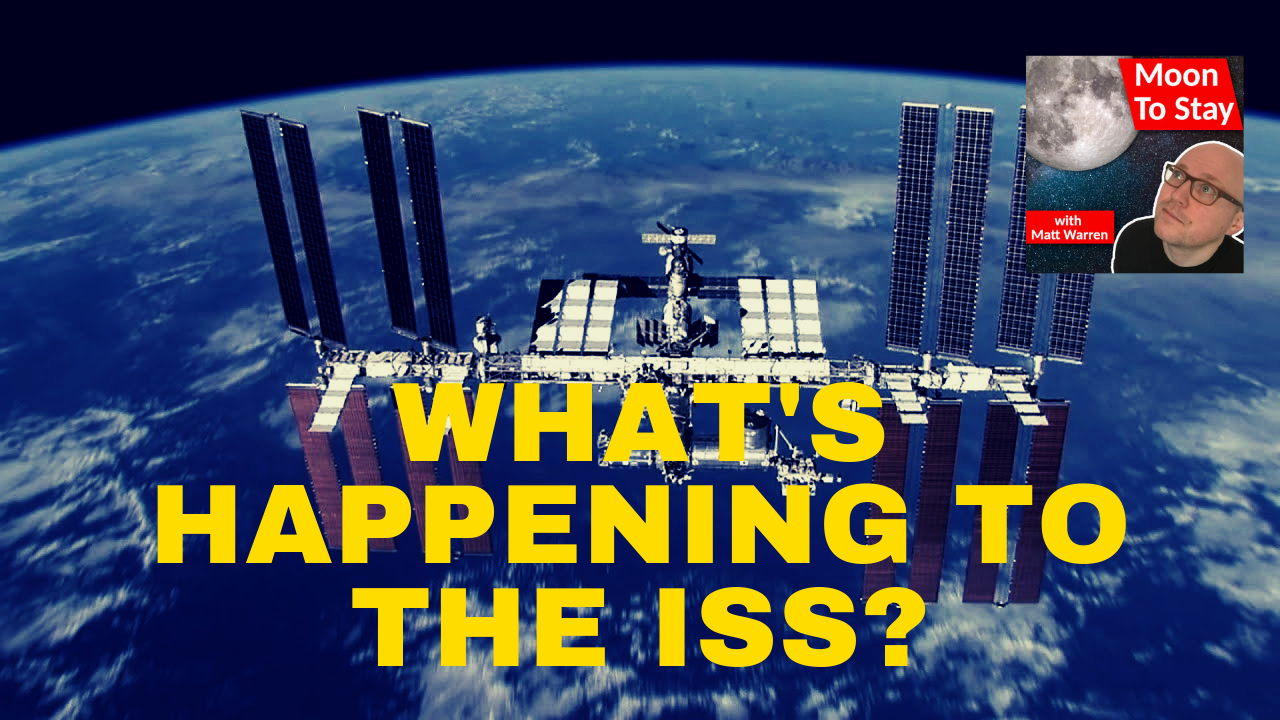
  • What’s going to happen to the ISS?

    What’s going to happen to the ISS?

    After two decades of ISS being the only game in town when it comes to space stations, things are finally starting to change. The decommissioning for ISS is in early planning stages now and the progress happening on new replacement stations from NASA and China, and perhaps Russia, as well as privately owned stations are starting to look like they are potentially close to finding a viable market. The future of space stations is looking bright.

    In 60 years of human space travel fewer than 600 people have been in space. And the maximum number of people who have been there at the same time is 13 – a record set in 1995.

    The good news is that since the ISS has become fully operational we have maintained a continuous presence in earth orbit. The ISS crew complement of between 3 and 6 people has been held since the year 2000. The limiting factor in putting more people up on the space station at the same time has not been the size of the station, but on our ability to have escape vehicle capacity to leave in the case of an emergency.

    The ISS is currently scheduled for end of life in the late 2020s. There have been discussions at NASA about how to do that. It’s a complicated international investment and different parties may have different ideas for what to do with the modules and equipment they have up there.

    In the case of the Russian modules, rumours are that they are investigating the potential of taking their components off to re-use on a Russian space station. NASA is potentially looking at the possibility of finding a way to off-load the operational aspects of the station to private industry. Certainly de-orbiting the whole thing would be dangerous and seemingly wasteful.

    China meanwhile has quietly already launched 2 short lived experimental space stations and is planning a larger modular Chinese station to call their own.

    NASA and international partners have shifted their focus to the new Gateway station. A small orbital outpost in heliocentric orbit of the moon – our first attempt at building something outside of Earth orbit. Though not designed to be permanently crewed, Gateway builds on the same modular design principles used for the ISS and will create new obligations to get astronauts out to lunar orbit on a regular basis for the foreseeable future.

    This is I think one of the biggest lessons from operating the ISS for the last 20 years. A great way at ensuring stable funding over a long time horizon, across multiple changes in governments is to have complex international agreements and sunk costs into the infrastructure that would be a waste to very publically abandon.

    In the private sector, things might finally be approaching a point where lower cost reusable rockets from SpaceX and Blue Origin make a privately owned and operated space station something that has a viable business case. NASA has been advancing a vision of increased private activity in space starting with the successful goal of privatizing the supply rockets to the ISS. Now they are looking into finding ways to make it possible for private industry to operate space stations.

    The best benefit from introducing multiple companies to operate at the same time (rather than picking a single contractor to build something like say – the space shuttle) is that we get diversity of ideas and visions. A variety of rockets to choose from, with different trade offs for cost, payloads, and scheduling. Paying companies for the service, rather than time and materials contracts puts pressure on the supplying company to work on things that can deliver value to more customers than just NASA. They still need to go out and drum up other business to make things work financially.

    When it comes to space stations we need the diversity of ideas more than ever, because there is wide open un-test potential for what to build, and unknown, untapped demand for things we might want to do in space if it was more affordable to do so.

    This is why companies like Bigelow aerospace has attached a test module to the ISS to validate it’s inflatable module technology and prepare for a more ambitious development of an orbital space hotel.

    Axiom space is a private company that likewise has developed conceptual modules for expanding the ISS and building independant space stations. They have proposed a future of expanding and replacing modules over time on ISS, essentially to rebuild it into something new.

    Blue Origin has submitted a proposal for a space station that looks to be based on a New Glenn upper stage. They are in the early stages of discovering the viable business strategy for building space habitats.

    Other companies like – SNC, Space Adventures, SSL/Maxar, Boeing, and Northrop Grumman all have their own visions for what the biggest opportunities are for using a space station be it for science, in space manufacturing, tourism or for servicing other activities in space.

    Space stations are central to the future commercialization of space and part of the bigger picture of expanding human influence out to the moon. We can’t have a human presence in space without a place for humans to stay. The rockets are coming that will make it more possible than ever to get people up in greater numbers and lower cost. The next challenge will be to build enough places for them to stay and work when they get there.

  • Growth Mindset

    I’ve been reading this book, Mindset: the new psychology of success by Carol Dweck. It’s been on my list of books to read for several years now and I’m finally catching up on the backlog.

    What finally brought it to the top of the list was finding out that this book is forming the basis of the corporate culture at the newly reborn Microsoft since Satya Nadella took the reins. Understanding what has changed at Microsoft to transform the company over the last while from a place that didn’t appeal to me at all just a few years ago, into a vibrant and positive company is interesting.

    The quick takeaway from the book is the distinction between having a fixed mindset and a growth mindset. These are not innate but are learned beliefs about various aspects of ourselves and others. For example, you might believe that IQ is a basic measurement of our core ability that doesn’t change. On the other hand, you might believe that IQ scores can change based on learning and training. These distinctions exist across a wide variety of our beliefs – Leadership, salesmanship, introversion, extroversion, personality, sports skills, music talent.

    The book re-enforced things which I believed to be inherently true, but framed the distinction between fixed and growth mindsets in a way that shone a light on people and interactions I have had in the past. And in that regard, I hope that it will help to make me more conscious of the distinction of foundational beliefs in future conversations

    Highly recommended book, which is becoming more important than ever as tribalism has reduced our ability to understand different perspectives.

  • Velocity vs Speed

    This past year has been one of the most interesting I’ve had. Quitting my job gave me the time to pursue a wide variety of interests. And I did use the time this year to get a lot of unique things done – blockchain development, built a chat/finance app, wrote a space strategy plan/planned a podcast, launched a couple dozen websites, built a beer fermentation cooler, did some e-commerce, designed a bike and custom electric motor, prototyped an AI app to learn Mandarin, designed a space launch system 1/100th the cost of SpaceX, invented a new scheme for proof of work, and designed a business strategy AI.

    These are things that wouldn’t have happened if I was also doing a job.

    However that variety and wide range of things had a drawback that very few of these things moved forward enough to get traction. Speed in lots of different directions, but low velocity. 

    My resolution for the next while is to plan and focus on velocity. To structure my time and the work I do to lead in a singular direction. 

  • Designing a Bike

    I love bikes, want to be able to use them more often than I do, and have been looking for something to do as a hands on project that doesn’t use the computer so much. Building my own bike seems like a neat and unique project.

    When thinking about what I would want in a bike there are a couple things that I would put as the most important design constraints.

    1. the frame should be as simple as possible, ideally something that has very few parts and could be manufactured entirely by robot.
    2. It should be hackable and extendable for easily adding trailers, baskets, etc.
    3. should allow for electric motor version with a mid-mounted motor.
    4. should should theoretically possible to make it very inexpensive to build.

    While thinking about and researching a lot of the existing products on the market I thought there was some opportunity to create something better and unique. It started with an electric motor and transmission design.

    I designed a motor integrated with the crank and isolated sprocket so that the pedals and motor can independently power the belt drive. This is housed in a single small unit and will allow for a simpler fixie style rear wheel hub while still allowing the pedals to idle. By moving most of the mechanical complexity into a single component which can be enclosed and made water tight it can be made maintenance free and high reliability.

    For the bike frame itself I want to think about something that requires no, or very little welding, ideally it would be made from as few parts as possible. Car unibody design gave me the idea of doing something with stamped metal sheets. I wondered if there was a way to build a bike frame from a single piece of metal with only a couple of mount points for the seat post, stem, rear wheel, and crank to attach to it. A key thing was to have a rear wheel mounted on only one side (like some motorcycles do). This allows the frame to be stamped out of a nearly rectangular piece of metal which reduces wasted scrap and eliminates many steps from traditional bike manufacturing.

    What’s next? There are two things I need to solve. Firstly, there’s a lot of engineering to refine the design enough to validate it. Secondly, I need to build a prototype. The steps and knowledge required to get to a testable bike is well outside my expertise so any realistic future where this gets built will need a team working on it. There are two ways that I could get this done. Either open source the bike design and try to attract a community to continue working on it or hire people. In either case one of the logical conclusions for this kind of project would be to do a kickstarter to fund production after the prototype is validated.

  • Soft Launching

    Last week I did a soft launch of the revamped Blockagram platform that I’ve been working on for the last while.

    Blockagram is a service that allows you to send messages to people for marketing purposes with a small amount of Bitcoin to incentivize them to both subscribe to your marketing list, and act on the messages they get.

    Ultimately, I hope to build it out to expand the number of services that businesses could make use of to spend Bitcoin, and that consumers could earn bitcoin from. It’s a missing part of the bitcoin economy that is preventing faster adoption. If businesses have opportunities to spend bitcoin on things that would drive more business then they would have an incentive to accept bitcoin for payments.

    It is a small step towards something bigger, and is the start of what has been the hardest part for me (historically) of shifting from exclusively development work to working on finding customers and operating the business.

  • Driving from Ottawa to St. John’s

    Over the last week I have been driving 3000km across Quebec, New Brunswick, Nova Scotia and Newfoundland to kick off a summer vacation.  We took the opportunity to stop and see a few things along the way.

    So many things to see in this country.

    Quebec City was a particular surprise. It was a beautiful city in general, and the old downtown and historic district was much more impressive and bigger than expected. I could have spent much more time wandering the back alleys and enjoying cafes.

    We managed to spend a day in Monteal, two in Quebec city, an evening in Fredricton and Antigonish, a couple nights camping in Gros Morne National park after taking the ferry from North Sydney, then booting it across the island to St. John’s.

    The night in Antigonish was a game day decision due to torrential rain that made it dangerous to drive – we didn’t make it as far as we wanted to that day.

  • Hypothesis Driven Business

    Over the last 5 years I’ve had the opportunity to integrate and work with about a dozen different companies – some big, some small, every one of them different from the others.

    One interesting approach that I have experienced over the last few months by one of those businesses is to take a scientific approach to business decisions. A feature change is driven to support some business or product goal, but there isn’t necessarily the assumption that a proposed change is guaranteed to address the goal.  It’s a Hypothesis. In an effort to test the hypothesis tools are needed to measure and assess the goal and an experiment needs to be devised to test it.

    In practice, this can mean many different things.  It might be that everyday someone has to collect numbers to update a spreadsheet, or that code is instrumented with extra logging or performance measurements, or that someone needs to create a report from old data. A quick prototype may be used to test a concept, or a bigger task may be broken down to a find a smaller initial experiment.

    Framing any proposed solution as a hypothesis has some interesting effects.

    1. hard to measure goals may get lower priority
    2. There is less stigma on wasted effort for a hypothesis that doesn’t result in attaining the goal – experiments are expected to fail
    3. It’s easier to think of taking a bigger task and find smaller experiments to prove the hypothesis before expanding scope
    4. metrics added to the product or business are additive. over time creating more insight that hopefully drive better future decisions
    5. Removing the assumption that an idea right lowers the inhibitions for everyone to contribute their ideas with less judgement
    6. Even when the CEO suggests something, it’s still an idea that needs to be proven with an experiment

    There are trade-offs.

    1. It takes extra time to record metrics and review the results
    2. Things that are difficult to measure may get under valued – ex. developer happiness, code cleanliness, velocity
    3. Experimental prototypes might stay in production for a long time
    4. overtime, adhoc data collection can result in extra complexity – things stored in different places by different people to answer different questions.
    5. small failed experiments part of a bigger hypothesis may result in half-implementations that were not worth finishing.

    Overall I think it’s an interesting way to drive the decision making processes within a business and something I will apply on future projects.

  • Crypto Currency Rabbit Hole

    Over the last several weeks I have been getting deeper and deeper with my crypto currency investments and knowledge.

    I have been a long time holder of bitcoin and purchased my first few way back in 2013 when 1.0BTC was roughly $50. I bought a couple more last year.

    In the most recent couple of months things have been exploding. The value of Bitcoin is up 75% in the month of August to a high of over $6000.  Needless to say I wish I bought more.

    For the last couple of months I have been watching my portfolio more closely and getting nervous about the security of my bitcoin assets as well as the lack of diversification of having everything in bitcoin when there are hundreds of newer and technologically better and unique blockchain based currencies and tokens available to buy.

    This past week I was reading a lot about ICOs and various new coins that are becoming available.  I bought some Ethereum, BAT and ARK.

    There’s some real hype around all this stuff that is bleeding into the public knowledge. Big companies are starting to test out some of the potential for applying blockchains to de-centralize various things. As a result demand is growing and valuations are skyrocketing.

    For sure, there are some sketchy things going on and many of these coins are doomed. But it seems like this is a technology that just isn’t going to go away.

    One growth investment thought experiment I’ve come to appreciate is to answer this question: “In 10 years will X be more or less relevant?”.  I think crypto currencies in general have a huge potential to become more important.  It’s something I’m planning on investing in much more over the next while.