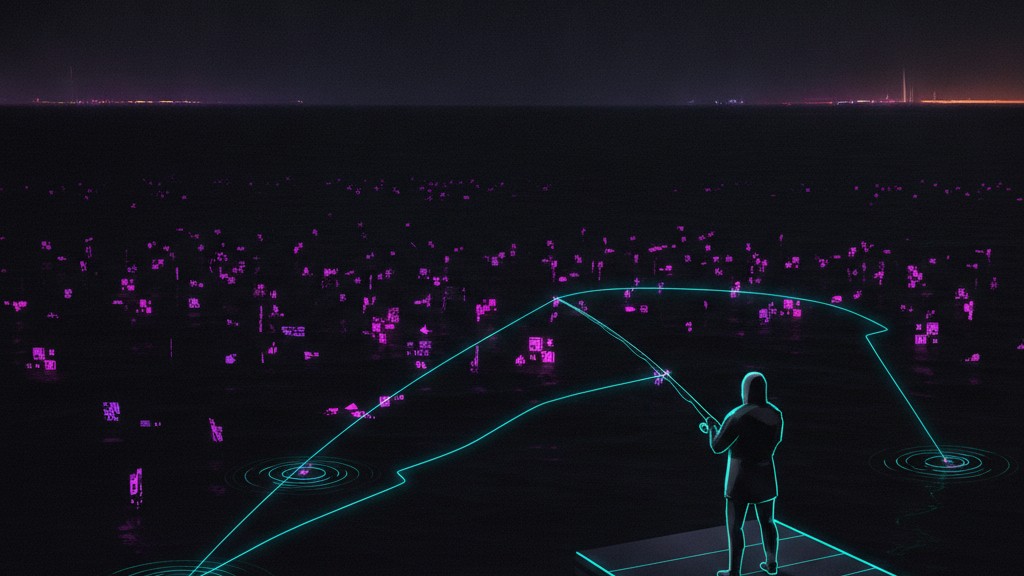
This is going to make a new kind of entrepreneur much more common.
They will not begin with a twenty-page business plan, a fundraising deck, or six months of product development. They will begin with an idea, give an agent a few hours, and put the result in front of real people.
Then they will do it again.
And again.
I am calling this Claude fishing: using AI agents to cast many small, real bets into the world and see which ones catch.
The name is deliberately a little unserious. The behavior is not.
It applies to a tiny SaaS tool, a calculator, a Chrome extension, a niche website, a mobile app, a video series, an interactive game, a data product, or a new distribution channel. The lure changes. The underlying move is the same: make something useful enough to test, publish it, watch what happens, and learn from the response.
For a long time, the cost of making a credible first version was the constraint. Soon, it may be the least interesting part of the work.
The old version of fishing was expensive
Entrepreneurs have always fished.
They bought ads to test a message. They built landing pages. They launched side projects. They wrote blog posts, sent cold email, ran events, released products, and waited to see whether anything pulled back.
The difference was the cost of each cast.
Building even a small product could take months. You needed a developer, a designer, a content person, a marketer, or enough skill to become all four. If the idea failed, the cost was not only money. It was the opportunity cost of the work you could not do while making it.
That naturally pushed people toward fewer, bigger bets. When each experiment costs a lot, you want a committee, a plan, and permission before you try it.
AI changes that equation.
An agent can now help research a market, build a landing page, make the tool behind it, write the onboarding flow, create the demo video, set up analytics, run tests, review the code, and deploy an initial version. It cannot make the idea good. It cannot guarantee demand. But it can remove a remarkable amount of the work between “this might be useful” and “someone can try it.”
That changes the economics of experimentation.
We are already seeing the first version of this
At the beginning of this year, I built Save.Cooking, a production recipe-management site with imports, accounts, public pages, a Chrome extension, and roughly a thousand recipes.
It took about two weeks. At the time, that felt fast.
Looking back only a few months later, the workflow already feels old. The process was still a sequence of small chunks: request a feature, review the implementation, test it locally, ask for the next feature, repeat.
Now the workflows around the models have improved enough that an agent can take on a larger task for hours: planning, implementation, tests, security checks, code review, deployment problems, and follow-up fixes. The operator is less often directing every individual keystroke and more often setting the target, checking the work, and deciding what should happen next.
That is part of what I mean by agentic-first development. Agents become useful when the work has a clear goal, useful tools, and a way to verify the result.
That is the shift behind the Save.Cooking experiment. The story was never that a model magically made a business worthwhile. In fact, AI was far more enthusiastic about building the product than it was useful at questioning the business model.
But the cost of getting a real product into the market fell hard.
That is enough to change behavior.
A fishing rod is not a slot machine
The lazy version of Claude fishing is easy to imagine.
Someone tells an agent to generate a hundred websites, a hundred videos, or a hundred copycat apps. They publish all of them. They call the output a portfolio.
Most of it disappears into the noise. Some of it creates more noise. None of it teaches the operator much because there was no clear hypothesis behind the work.
That is not a strategy. It is spam with better tooling.
The useful version is different.
Each cast needs a reason to exist. A clear audience. A small but real problem. A way to tell whether anyone cares. A limited amount of time and money. And a decision rule for what happens after the data comes in.
Think of it less like throwing random objects into the ocean and more like learning how to fish:
- Pick a specific pond.
- Choose a lure based on a real observation.
- Cast quickly.
- Pay attention to what bites.
- Keep the signal. Change the lure or leave the pond when nothing happens.
The output might be a product. It might be a lesson that the market does not care. Both are valuable if the experiment was designed well.
The bottleneck moves from building to choosing
When implementation was expensive, many good ideas died before they were tested.
When implementation becomes cheap, a different problem appears: there are too many things worth testing.
That makes judgment more important, not less.
What audience is underserved?
What problem is painful enough that a person will change behavior?
What can be tested in a week instead of imagined for a quarter?
What signal counts as a real bite: an email address, a purchase, a retained user, a referral, a reply from someone who fits the audience?
Those are not coding questions. They are product, market, and taste questions.
This is also why the idea that everyone will become a software founder is only half right. More people will be able to make software. The durable advantage will belong to people who can notice a real opportunity, frame it clearly, and recognize whether the result solves the intended problem.
AI can make a beautiful lure. It cannot decide which lake is full of fish.
The operating system is becoming malleable
This feels bigger than a new code-generation trick because the same pattern is moving closer to the computer itself.
Omarchy, DHH’s Linux distribution, describes itself as a “malleable OS for the age of agents.” It puts AI-agent tooling next to an extensible plugin system. Asking for a custom calendar, tracker, or workflow starts to feel like a normal computer task, not traditional software development. Omarchy’s own description is striking because it does not present AI as a separate application. It presents the computer as something you can reshape with an agent.
That is a preview of a broader change.
For decades, most people used software made by someone else. A smaller group could configure it. A much smaller group could build it.
The boundary between those groups is starting to soften.
The old science-fiction version was a person speaking to a computer and watching a custom system appear. Star Trek’s holodeck was the clearest version. Describe a setting, a character, or a scenario, and the computer makes it real.
We are not there. Real systems still have constraints: data, security, permissions, maintenance, distribution, and the inconvenient fact that users do not automatically appear because an app exists.
But we are much closer to the interaction model. “Make me a tracker that does this” is beginning to be a reasonable starting point, not a fantasy.
The noise will be enormous
The internet is about to fill up with good-quality work.
Not only AI sludge. Good work. Useful calculators. Niche websites. Polished videos. Stories. Podcasts. Plugins. Mobile apps. Small software products that would have required a real team a few years ago.
There will be thousands of text editors, each with a slightly different set of tweaks. There will be trackers, dashboards, newsletters, games, marketplaces, browser extensions, and strange little tools for narrow problems that only a few people have noticed.
Some of it will be excellent. Most of it will be invisible.
That is the other side of Claude fishing. Casting gets easier, but every pond gets crowded.
Discoverability was already hard. It is going to get much harder when thousands, then tens of thousands, then perhaps millions of people can make and publish credible work in a few hours. A good idea will have more competition for attention than it would have had before the idea even existed.
Algorithms will still find some viral moments. A video will break through. A Product Hunt launch will catch. A Hacker News post will pull in the right group of people. A niche community will decide that a particular tool is exactly what it needed.
But every one of those channels becomes more competitive when the supply of decent work explodes.
Visibility may become the expensive part
If building becomes cheap, getting noticed may become the cost center.
People will still need to find the right audience. They will still need a story that travels, a community that cares, an introduction, a partnership, a good post, a useful demo, or a friend who shares the idea with the right person.
And some of them will pay for it.
It is easy to imagine a bigger migration toward paid visibility. Not because paid distribution is new, but because it becomes much more attractive when a person can make ten credible products before lunch and none of them have an automatic way to reach users.
The weird future is not one where there is no competition because AI makes creation easy. It is one where the competition gets fiercer because creation is easy for everyone.
Projects will start and disappear quickly
This will also create a huge graveyard of half-lived projects.
Someone will have an idea on Tuesday, ask an agent to build it, show friends on Wednesday, and move on by Friday. That is not always a bad outcome. A short-lived project can still be a useful experiment, a portfolio piece, a lesson, or the first version of something that comes back later.
But it will be a different rhythm from the old startup model. More projects will begin. More projects will be abandoned. The distance between curiosity and a launch will collapse, so the distance between a launch and abandonment will collapse too.
That may be chaotic. It may also be fun.
The practical way to start is to make something
There is no special research ritual required before you can Claude fish.
If you have an idea, ask an agent to build it. Ask it to publish it. Put the idea in front of people. Tell them why it exists. Make another thing when the next idea arrives.
- Take your idea and ask an agent to build it.
- Ask the agent to help publish it.
- Get the word out and share the idea.
- Keep making things. Cast as many lures as you can manage.
- Join communities, make friends, and trade ideas.
That is not a complete theory of how to start a business. It is not a promise that every cast will catch. It is simply the posture that this new environment rewards: make the thing you want to exist, show it to the world, and see what comes back.
This is a time for more people to be fishing, building, and making.
AI does not remove the need for taste. It lets more people act on it.
That is Claude fishing.
