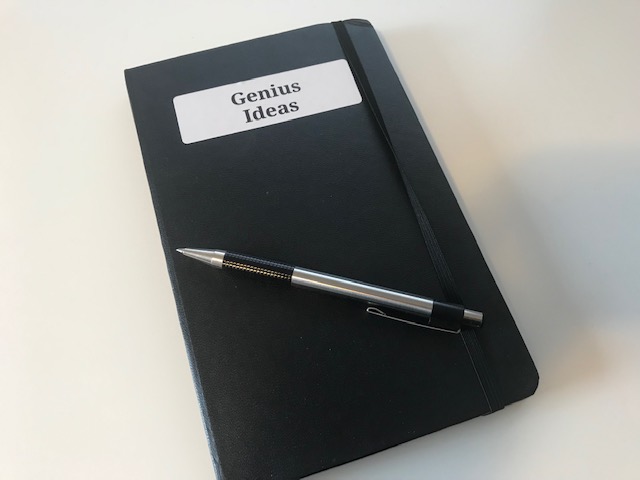
Last year I started a notebook specifically to collect ideas that I feel are particularly innovative or interesting. I keep it on my desk – one of the few things.
While I believe that ideas are usually worthless without taking the action to implement them, or at least further investigate their feasibility. Collecting ideas into one place has some value. It becomes a source of inspiration to draw from when feeling bored.
Good ideas take time to form and a notebook is a good place to mix words and sketches and build the idea over time until they become more fully developed. I tried iPad notebooks, which with the pencil has good support for sketching, but digital things tend to get lost below the fold in a way that physical books on a desk do not.
What are some of my ‘genius ideas’? I’ve got a space launch system that doesn’t need rockets which I’m trying to solve for a lower scale system that would still have a viable market. I collected ideas for a unique proof of work algorithm, and AI system for learning languages, an inline electric bike pedal assist motor, the vision for a Canadian moon mission, inflatable furniture, and more.
When inspiration strikes I try to write it down. Sometimes those ideas are fleeting and it’s good to catch them before they are forgotten.
Over the years I have done a lot of things. much of that history is documented on this website, but much more isn’t. Many of my projects and business ideas were purposely separated from my personal site and I didn’t even reference them here or elsewhere. Some of that was to avoid sharing more failures, some was to give things a chance to prove themselves without the influence of family and friends.
I’m starting to have a change of heart. So I’m revisiting this website and will be slowly turning it into more of a nexus of every project that I’m working on and as a hub for the businesses that I’m launching.
You may have noticed that I added some links to the top level navigation on this page. The Moon To Stay Podcast is a project I’ve been working on for the last 2 months. Writing and preparing to record a series of podcasts all about the moon. When thinking about this project I originally thought about creating a new website for it – buy the domain name, build a podcast specific site to host the feed, and show notes.
The more that I thought about it though, the goals of the podcast is really about myself. Gaining confidence with speaking, interviewing, and recording. Showcasing some expertise and interest in the subject, and attempt to have some personal impact on humans in space. Doing a commercial style thing just doesn’t fit with that set of personal goals.
So I’m putting the podcast on this website.
The decision got me thinking about some of the other things that I work on that I haven’t really integrated with this personal blog. It’s important to celebrate your successes, and promote the work you do. If nobody knows about all the great things you do, then nobody will every find and use it. Communication of all these things is and important aspect of giving value to the world.
So one of the tasks I have for myself for the rest of January is to pull in a lot of different things to this website that show off things I am currently working on, and show some of the historical projects that have been done before.
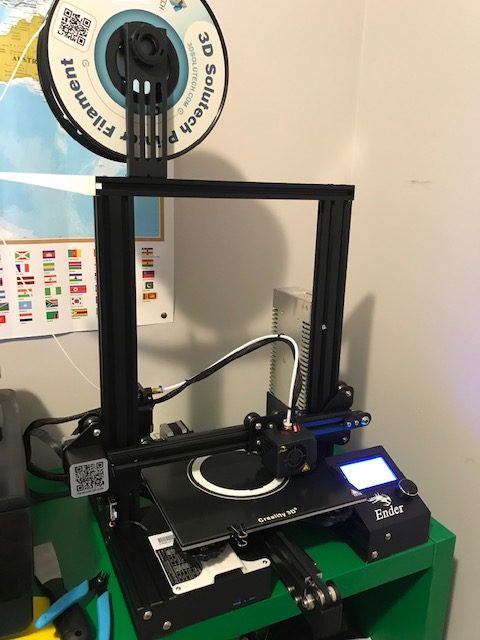
For Christmas this year, I got a 3D printer to add to my ever busier home office. My hope with the printer is to create more in 2019. And I have a backlog of ideas for things I want to make with it.
I hit a wall with my bike design a couple months ago due to lack of tools to take things from a sketch and 3d model into a prototype phase. I hit the same wall earlier in the year trying to prototype an active support structure. My hope is that a 3D printer will let me take some of these ideas and make functional prototypes, or make the jigs and tools to help me make them.
In addition to the ambitious things, there’s plenty of little things that these printers are particularly good at. Wire clips, mounting hardware, models and little odds and ends that I hope will keep my office neat and tidy will be fun to play with.
While I wait for a couple pounds of plastic filament to arrive I’m combing through the 1,000,000+ models on thingiverse looking for stuff to print.
This past year has been one of the most interesting I’ve had. Quitting my job gave me the time to pursue a wide variety of interests. And I did use the time this year to get a lot of unique things done – blockchain development, built a chat/finance app, wrote a space strategy plan/planned a podcast, launched a couple dozen websites, built a beer fermentation cooler, did some e-commerce, designed a bike and custom electric motor, prototyped an AI app to learn Mandarin, designed a space launch system 1/100th the cost of SpaceX, invented a new scheme for proof of work, and designed a business strategy AI.
These are things that wouldn’t have happened if I was also doing a job.
However that variety and wide range of things had a drawback that very few of these things moved forward enough to get traction. Speed in lots of different directions, but low velocity.
My resolution for the next while is to plan and focus on velocity. To structure my time and the work I do to lead in a singular direction.
I love bikes, want to be able to use them more often than I do, and have been looking for something to do as a hands on project that doesn’t use the computer so much. Building my own bike seems like a neat and unique project.
When thinking about what I would want in a bike there are a couple things that I would put as the most important design constraints.
the frame should be as simple as possible, ideally something that has very few parts and could be manufactured entirely by robot.
It should be hackable and extendable for easily adding trailers, baskets, etc.
should allow for electric motor version with a mid-mounted motor.
should should theoretically possible to make it very inexpensive to build.
While thinking about and researching a lot of the existing products on the market I thought there was some opportunity to create something better and unique. It started with an electric motor and transmission design.
I designed a motor integrated with the crank and isolated sprocket so that the pedals and motor can independently power the belt drive. This is housed in a single small unit and will allow for a simpler fixie style rear wheel hub while still allowing the pedals to idle. By moving most of the mechanical complexity into a single component which can be enclosed and made water tight it can be made maintenance free and high reliability.
For the bike frame itself I want to think about something that requires no, or very little welding, ideally it would be made from as few parts as possible. Car unibody design gave me the idea of doing something with stamped metal sheets. I wondered if there was a way to build a bike frame from a single piece of metal with only a couple of mount points for the seat post, stem, rear wheel, and crank to attach to it. A key thing was to have a rear wheel mounted on only one side (like some motorcycles do). This allows the frame to be stamped out of a nearly rectangular piece of metal which reduces wasted scrap and eliminates many steps from traditional bike manufacturing.
What’s next? There are two things I need to solve. Firstly, there’s a lot of engineering to refine the design enough to validate it. Secondly, I need to build a prototype. The steps and knowledge required to get to a testable bike is well outside my expertise so any realistic future where this gets built will need a team working on it. There are two ways that I could get this done. Either open source the bike design and try to attract a community to continue working on it or hire people. In either case one of the logical conclusions for this kind of project would be to do a kickstarter to fund production after the prototype is validated.
It was two years ago that I learned about a system of keeping an agenda/journal that really made sense to me. Bullet Journal is a flexible way to organize a plain physical journal so that you get exactly what you want out of the practice without the rigid space limitation and structure of pre-printed agendas or digital note taking apps.
I have tried various attempts to use things like Evernote, Google Docs, Apple Notes, and a few smaller todo list apps. All of them suffered from a lack of physicality. Apps disappear into the background or get forgotten about when the browser tab is closed. It is easy to copy/paste huge amounts of content into an app that you will never read and won’t remember.
A journal that sits on my desk has a permanent presence. Looking at it is a reminder to continue with the ritual and to revisit my goals on occasion. Everything in it has to come from my own written hand which makes it easier to remember. Hand writing takes more time to do, and that is kind of the point. By taking up physical space as a book with a single purpose, and by requiring time each to consciously think about it and write in it adds to the importance and effectiveness.
By asking simple questions every morning: “what is the date?”, “what do I want to accomplish today?” “What events do I have today?” and then taking time to flip back though pages occasionally to answer these questions, each day is given more intentionality. It makes me feel like I’m writing my own life instead of having Google Calendar dictate it to me. Some things in life are better left not automated.
I have been finding myself increasingly frustrated with the amount of American news that I see as a Canadian. On many topics it seems like I know more about what is happening in another country than in my own. A sad state of affairs. Most of these things are actually meaningless to me personally. Decisions made by American politicians are unlikely to cause me to change anything in my day-to-day, affect my decisions or something that I would have influence on. As a result, everything I know about American politics represents wasted neurons and wasted time.
American News is a drama. The characters and their emotional conflicts play a staring role keep us hooked like a soap opera. It draws us back in day after day to find out what happens. It stays on our mind through the day, speculating about what will happen next.
It made me think about all the media I consume.
Increasingly I have been withdrawing from all consumption channels. With Facebook, I have disabled all notifications, and log in less than once a month. I stopped using my feed reader and unsubscribed from everything that explicitly was world news related at the beginning of the year. Yesterday, I purged my phone of Reddit, CBC News, and Pinterest. The last of my consumption-only news feeds. Twitter is my only remaining source of outside information – but I’m careful about who I follow.
Either you control your brain, or your brain controls you. I want to make sure I am consciously in control of my own brain by ensuring that what goes into it aligns with my goals, that I reduce my risk of being influenced by media hype or fear tactics.
My goals are that I want to be building as much as possible. To focus on creation, I’m limiting the hours spent consuming.
The consumption that I am trying to do more of is books. The ideas in books have been baked for years before they make it to the printed page. They undergo multiple levels of review and editing before publishing, and they have the length to more fully explore and explain things. Choosing a book to read also aligns with the desire to control what goes into my brain which is very different from the lack of control we get from skimming through clickbait headlines.
As I have been cutting down on media consumption my phone has become less and less useful. I’m thankful of that, since it gives me more time in the day to be the author of my own future.
If the climate models recently published by the IPCC are accurate, then things are not looking great for the future. Indeed, if we continue on the same path that we are currently on then it is unlikely that my daughter will live long enough to die of old age.
When rising ocean levels force a mass migration in India and other highly populated coastal cities, then our recent experience with the mass migration of Syria foretells just how bad of a situation it could be.
More frequent and more intense storms threaten to destroy our infrastructure and homes. Increasing droughts and desertification put our food production at risk.
It is a seriously bad situation.
We know the cause. Greenhouse gasses in the atmosphere are capturing more of the suns energy. It’s our fault. But even if it wasn’t, we still need to do something to stop it from getting worse.
There are a few things we can do, and there are multiple concurrent things we need to work on.
Everyone’s next car should be electric. The shift to electric transportation is critical to staying below a habitable temperature increase.
Minimalism. I’ve come to the conclusion that I don’t like having stuff. There’s a lot of wasted time and money on things we don’t need. I’m trying to reduce my consumption of things as low as possible.
Eat less meat. Cows are a horribly inefficient way to grow food calories and nutrients. We’ve cut our meat consumption way back and eat more vegetarian meals than we used to.
We should be encouraging Plan B options. Elon Musk’s colony on Mars or Jeff Bezos’ vision of living in space needs some serious consideration and funding.
We need some geo-engineering technology to sequester carbon out of the air.
Urban planning needs to take a good look at efficiency. Higher density housing, and mixed-use zoning make walking, biking, or mass-transit an option for more of our trips.
Right now it seems like we are living on the edge of it being too late to act. IPCC has determined that a 1.5 degree rise is only possible with carbon sequestration technology that currently doesn’t really exist. Current government policies are on a course for an unlivable planet.
This century is looking pretty bleak to me right now.
Last week I did a soft launch of the revamped Blockagram platform that I’ve been working on for the last while.
Blockagram is a service that allows you to send messages to people for marketing purposes with a small amount of Bitcoin to incentivize them to both subscribe to your marketing list, and act on the messages they get.
Ultimately, I hope to build it out to expand the number of services that businesses could make use of to spend Bitcoin, and that consumers could earn bitcoin from. It’s a missing part of the bitcoin economy that is preventing faster adoption. If businesses have opportunities to spend bitcoin on things that would drive more business then they would have an incentive to accept bitcoin for payments.
It is a small step towards something bigger, and is the start of what has been the hardest part for me (historically) of shifting from exclusively development work to working on finding customers and operating the business.
Last night I was attempting to learn a little bit of Chinese after being inspired from a series of documentaries and travel vlogs (ChopStick Travel) that I’ve been taking in over the last 3-4 weeks.
Anyway, I opened up DuoLingo and was quickly disappointed. Then I tried Memrise, which was slightly better, but it suffered from the same issues.
Most critically, these apps fail because they have no variability. Every time you hear the recording of “nĭ hăo” it is the exact same one. Every time you see the script written “你好” it uses the same font.
Deep learning is a mathematical approximation of how the neuron’s in our brains work. At least when you compare to very simple brains like those in worms, current AI tech is a reasonably good simulation. I think it’s reasonable to assume that we can gain insight into the human brain from things we learn developing AIs.
When we build these simulated neural networks how they are trained is critically important to how they perform. For instance: training a computer to understand spoken language requires an immense number of audio samples (Mozilla’s open data set is currently at 12GB of compressed audio). When training an AI to do visual character recognition it takes thousands of samples to get a good working model. Elon Musk has said they need 1 billion miles of recorded driving to get a reasonable self driving model. AIs need a LOT of data to train on.
Granted the human brain is vastly better at learning than current Deep Learning AI algorithms, but we are not so much better that we can learn new words with a single sample. Hearing a word said in one way, recorded on a sound stage will do very little to help recognition when you hear it in person outside at a loud food market, or with a different accent, even a cadence change might throw off your comprehension.
If you came to an AI expert to get a voice recognition system trained and you had spent $50,000 at a sound studio getting one perfect example of each word to use as your training data. You’d be laughed at for wasting so much money on something so useless. It is preposterous to train AI on single sample sizes, but that seems to be what we expect to happen with people.
I wish there was a language learning platform that took the approach of compiling a minimum of 100 samples of each word (at least at the beginning levels) ideally taken in-context with video so you can see the facial movements and pick up on body language. It could initially seed the library of data with clips from YouTube or movies. Over time it could ask users to contribute snapchat style short clips of them saying words/phrases in their native language to help others on the platform. A particularly memorable clip might be the one that cements the word in your memory, and hearing all the variations will help train your ear to recognise the word. It could use image recognition AI training sets avoid learning a mental translation process that slows down fluency.
Using the same kind of data we use to train a Deep Learning algorithm but use it to train humans would be super interesting. It might unlock insights in psychology, education and computer science.
As an endeavour it would be awesome to have 10 new people try the app every month and do a 1 hour session on-site with a new language. Then see how much they get through a conversation with a native speaker afterwards. Optimise the app over time for real improvement with comprehension and perhaps conversation. Language learning is an ideal case for testing the limits of how quickly humans can learn something new.
Perhaps a billion dollar idea if only I had the capacity to pursue it. (the amount of user contributed data could be a gold-mine if it worked)